For a single clinic, salon or studio, a ready-made booking system is usually the right answer. It is quick to set up, cheap each month, and someone else keeps it running.
The trouble starts with growth. A second and third branch, prepaid packages, treatment records and a POS at each counter push a ready-made clinic booking system into jobs it wasn’t designed for. Staff fill the gaps with spreadsheets and WhatsApp.
When ready-made is enough
- One or a few outlets.
- Standard appointments: a service, a staff member, a time slot.
- Online booking, reminders and perhaps a deposit.
- Reports you can live with as they come.
If that is you, choose a good product and spend the money on marketing instead.
Signs you’ve outgrown it
- Customers buy a package at one branch and use it at another, and staff track the balance manually.
- Staff need treatment or service history before each session.
- Bookings, sales and invoices live in different systems, and someone reconciles them.
- Staff commission is worked out in Excel.
- You want customers to book in your own app, under your brand.
- Management can’t see all branches in one report.
What a multi-branch system holds
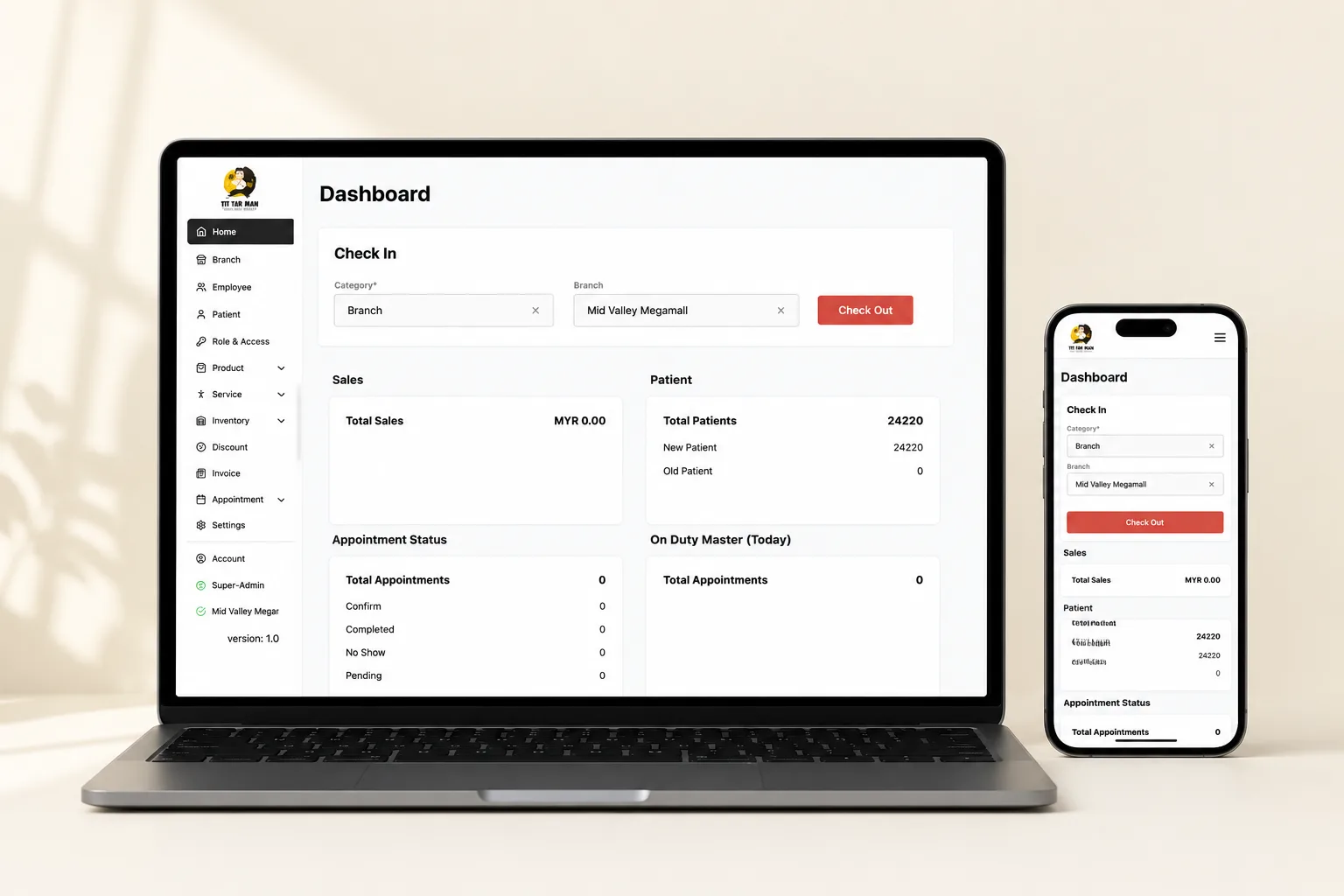
For Tit Tar Man, a bone-setting and body alignment specialist with several branches, we built both sides from scratch.
For branch staff, a web-based clinic and point-of-sale system covers:
- branches and employees;
- patient records and appointments;
- products and services, prices and discounts;
- treatment packages and invoices.
For customers, a mobile app connected to the same system lets them browse services, find a branch, book and change appointments, and see their treatment history and packages.
The hard part wasn’t any single screen. It was turning how the clinic really works into software staff would actually use, while keeping the customer side simple.
Health records change what the system must do
Under Malaysia’s PDPA, information about a person’s physical or mental health is sensitive personal data, and it may only be processed with their explicit consent.[1] If your booking system keeps treatment notes or health conditions, that affects how it is built:
- Consent, captured and recorded for each customer.
- Access by role, so front-desk staff see appointments and practitioners see the treatment notes.
- A record of who opened what.
- Backups and hosting in your company’s name, with clear records of where data is stored.
A ready-made app built for salons may not have been designed for any of this.
A middle path
You don’t always have to replace everything. Some businesses keep a ready-made booking app for the customer side and connect it to their own system for packages, history and invoices. It works when the booking app has a usable API and the rules are simple enough to split. Our integration worksheet helps you decide.
What it costs
A staff system with a customer app is a mid-sized build. Our guide to software costs in Malaysia has the ranges. Compare it with what the ready-made app costs across all branches over a few years, plus the staff time spent working around it.
Common questions
Can we move our data out of the ready-made app?
Check before you need to. Ask the provider for a full export of customers, bookings and package balances, and look at what actually comes out.
Do our customers need an app?
Not always. A booking page on your website can do the job. An app makes sense when customers book often, follow a treatment plan or use packages.
Can the booking system connect to our accounting software?
Yes. Invoices and payments can flow into your accounting system. Decide which system owns each record first.
How we can help
A system for several branches keeps growing with them: a new branch, a new package, a new report. See how we build custom POS and booking systems in Malaysia, usually on Managed Delivery at RM19,000 a month with full technical ownership, with the first release kept small and the rest added one priority at a time. Staff can stop working around the booking app, one branch at a time.
Not sure whether to keep the ready-made app? A Decision Review gives you a written second opinion for RM1,000. When you want a fixed price for a settled scope, we start with a separate paid Scoping & Blueprint phase (from RM5,000) that your company owns, and build it as a Custom Project, from RM30,000.
Sources
Company guides are published by software companies about their own market, not independent surveys. Treat their figures as a rough guide.
- 1.