

How to choose a software development company in Malaysia
Seven steps before you sign: check you need custom software, set a budget, write a brief, check the company, compare quotes and keep the code yours.
Rosaan Ramasamy · · 7 min read
When a ready-made loyalty platform is enough, what sits behind the member’s screen, why the POS and ERP links are the hard part, and what it costs.

In short
Use a ready-made loyalty platform if you are one brand with standard points. Build your own when points must work across outlets or businesses, connect to your own POS or ERP, follow your own rules, or live in an app that does more. Most of the work is behind the member’s screen: earning and redemption rules, the connections to the systems where people spend, a back office and fraud controls. A wallet that holds members’ money raises Bank Negara’s e-money rules, so take legal advice before building one.
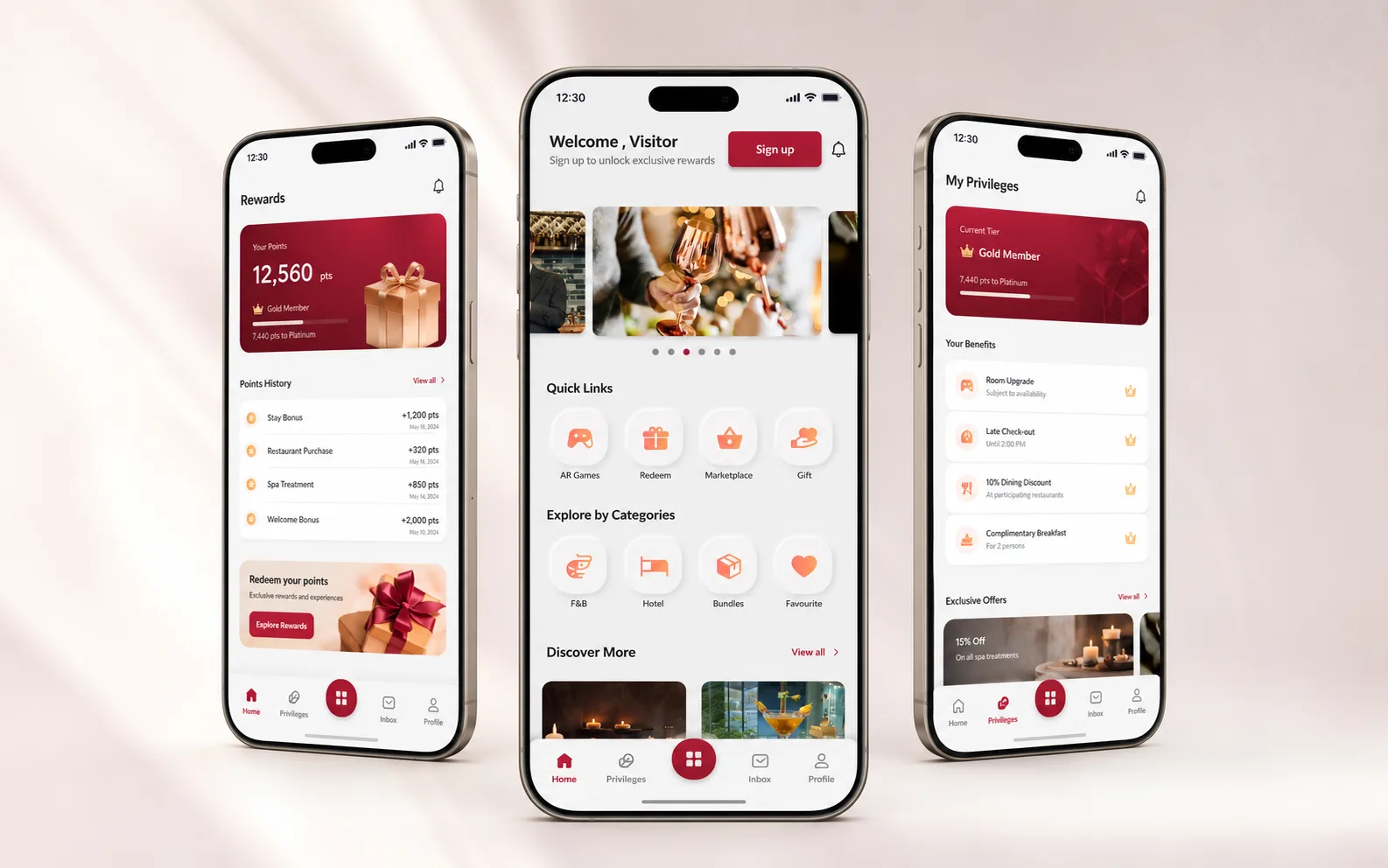
To a member, a loyalty app is three things: see my tier, earn points, use them. That simplicity is the point, and it is also why loyalty app development gets underestimated. Most of the work sits behind the screen. It is also why quotes for the same loyalty app can be far apart: they price different amounts of what sits behind it.
A ready-made loyalty platform suits a single brand with standard rules: points per ringgit spent, a few tiers and some vouchers. You pay a monthly fee, often by the number of members or outlets, and the provider keeps it running.
Your own app makes sense when:
Points come from where people spend. If that is a POS at each outlet, every POS vendor is a separate connection, and some will be easier than others. If finance needs to see points as a liability, the loyalty system has to talk to the accounting system or ERP as well.
Find out early which systems are involved and who controls each one. The app screens are the easy part to estimate. The connections are where the surprises are. Our integration worksheet helps you list them.
Points that can only be exchanged for rewards are one thing. A wallet that members top up with money and spend is another. Bank Negara regulates e-money, and a 2024 exemption order takes limited-purpose e-money out of its main e-money rules.[1]
Which side of that line your wallet falls on is a question for a lawyer, and it should be answered before the wallet is designed.
A member app with accounts, a back office and connections to other systems is a mid-sized build. Our guide to software costs in Malaysia has the ranges. Budget for running costs too: hosting, app store accounts, push notifications and text messages. Apps also need updating every year, even when nothing is broken.
For AWC, a group of hotels, retail and commercial properties, we built the AWC Infinite Lifestyle app. Members manage their tier, points and benefits across the group’s businesses in one app. It has an eWallet for cashless payments, eKYC to verify each member, and an integration with SAP for the group’s finance data. Consent is captured for each purpose, in each language the app supports.
For TCE Baby, parents collect points and win cashback at the expos. Crew at the counters verify visitors and add points for what they spend, so the earning happens at the event, not only in the app.
For occasional use, a website or a page in your existing app can work. An app earns its place when members use it often, at the counter or for notifications.
You should. Keep the database, the app store accounts and the hosting in your company’s name. Who should own the code, hosting and accounts? covers the rest.
Yes, and it is usually wiser. Start with earning and redeeming at your main outlets, then add partners, campaigns and tiers once you see how members use it.
Malaysian app developers price an app with accounts, payments and a back office at about RM50,000 to RM150,000. Connections to an ERP or CRM push it towards the next band up.[2] A ready-made platform costs far less to start, and charges every month.
Start small: earning and redeeming at your main outlets first, then campaigns, partners and tiers once you see how members use it. That is how Managed Delivery builds, from RM13,000 a month, one priority released at a time. Members get something real early, and the rest of the budget goes on what they actually use.
Not sure whether to build at all? A Decision Review gives you a written second opinion on buying a platform or building, for RM1,000. When the scope is written and fixed, the build can be a Custom Project, from RM30,000.
Company guides are published by software companies about their own market, not independent surveys. Treat their figures as a rough guide.
Official
Policy Document on Electronic Money (E-Money) (opens in a new tab)Bank Negara Malaysia, 2025. Checked 24 October 2026.
Company guide
App Development Cost in Malaysia, Pricing Guide (opens in a new tab)Advisory Apps. Checked 24 October 2026.
Founder and Managing Director, Antdragon
Rosaan started Antdragon in 2020 to be the team that stays accountable once software goes live, and works with business owners on the systems they rely on every day.
Filed under Planning new software
Seven steps before you sign: check you need custom software, set a budget, write a brief, check the company, compare quotes and keep the code yours.
Rosaan Ramasamy · · 7 min read

Before you buy an ERP system, find the part your accounting package can’t handle. Four ways forward, and how AutoCount and SQL Account connect.
Rosaan Ramasamy · · 4 min read

A copyable brief that helps a software team understand users, workflows, priorities, constraints, dependencies and how you will accept the work.
Rosaan Ramasamy · · 2 min read