In many larger companies, SAP holds the core financial and operational records: customers, materials, prices, orders and invoices. So almost anything new eventually needs SAP integration, whether that is a customer app, a dealer portal, a loyalty programme or an e-commerce store.
The code for that connection is rarely what takes the time. Agreeing what crosses over, and getting the SAP side’s time and access, usually does.
And if you run SAP ECC, the deadline is already approaching. SAP’s mainstream maintenance for the latest ECC releases ends at the end of 2027.[1]
First, which SAP?
“SAP” covers very different systems, and each connects differently.
- SAP Business One, common in small and mid-sized companies, has the Service Layer: a REST API that goes through the same business rules as the SAP screens, so the same checks apply.[2]
- SAP ECC, the older SAP ERP 6.0, is still widely run. SAP’s mainstream maintenance for its latest enhancement packages ends at the end of 2027, with optional extended maintenance from 2028 to the end of 2030.[1]
- SAP S/4HANA is SAP’s current ERP. SAP has committed to keep at least one release of it in maintenance until 2040.[1]
Why the 2027 date matters for what you build now
If your company runs ECC, a move to S/4HANA is either planned or overdue. Anything you connect to ECC today may need connecting again after that move.
So build the connection with a layer in between. Your app talks to that layer, and only the layer talks to SAP. When SAP changes, you change the layer, not the app.
What to agree with your SAP team first
- Which records cross over: customers, materials, prices, stock, sales orders, invoices, or loyalty points posted to finance.
- In which direction, and which side owns each record.
- How often: as it happens, every few minutes, or overnight. Real-time is not always needed, and it costs more.
- A test system. Building against the live SAP is how month-end goes wrong. Ask for a test environment (for user acceptance testing, or UAT), with realistic data.
- Their time. Your SAP team or SAP partner will need to explain custom fields, set up access and sometimes configure the SAP side. Book that time before the work starts.
- What happens when SAP says no: a blocked customer, a closed period, a locked record. Decide who is told and what the app shows.
Where it usually gets stuck
- No test environment, or one with no useful data.
- Custom fields and rules nobody documented, added over years.
- Access: a technical user with the right permissions can take weeks to approve.
- The SAP partner’s calendar. They have other clients, and a month-end freeze.
None of these are code problems. They are why the conversations with the SAP side should start first.
What we built for AWC
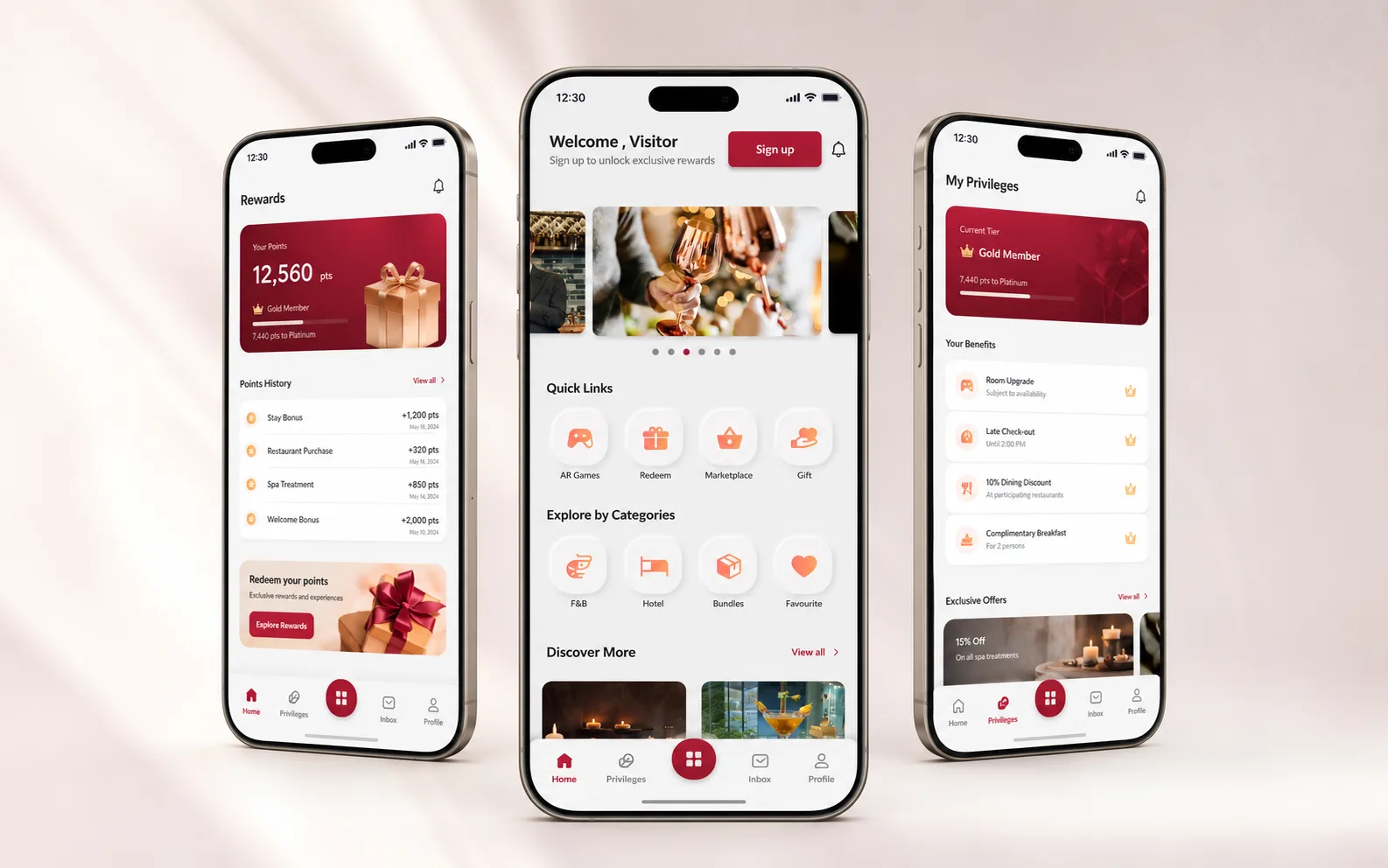
AWC is a group of hotels, retail and commercial properties. Its loyalty app, AWC Infinite Lifestyle, lets members manage tiers, points and benefits across the group. Behind it, the loyalty platform is linked to SAP for the group’s finance data.
We built the backend in Django on MySQL and tested it against AWC’s own UAT environments as each enterprise service was connected. The platform now runs linked to SAP in production, and the members never see the complexity.
Common questions
Do we need our SAP partner involved?
Almost always. They know your SAP setup, they control access, and some connections need configuration on the SAP side. Plan the work with them, not around them.
Can we connect without changing SAP?
Often, through SAP’s standard interfaces. Sometimes the SAP side needs a small custom service, which your SAP partner builds. Find out which before anything is quoted.
Should the app read from SAP directly every time?
Usually not. Keeping a copy of what the app needs, such as prices or a member’s points, and refreshing it regularly keeps the app fast. It also keeps working for a while if SAP is down.
What is SAP integration?
Connecting another system to SAP so records move between them without anyone retyping them: customers, prices, stock, orders, invoices, or points posted to finance.
When does support for SAP ECC end?
SAP’s mainstream maintenance for the latest enhancement packages of SAP ERP 6.0 runs to the end of 2027. Optional extended maintenance runs from 2028 to the end of 2030.[1]
How we can help
Integration around SAP rarely ends with one connection. There is the next portal, the next set of records and, on ECC, the move to S/4HANA. See how we approach system and ERP integration. We usually run it on Managed Delivery, starting with your SAP setup and your SAP partner’s part, then releasing one priority at a time. For larger organisations, the Enterprise level, from RM30,000 a month, adds governance and procurement support.
Your SAP team gets one accountable counterpart, and the connection is looked after as SAP changes.
If procurement needs a fixed price for a settled scope, we start with a separate paid Scoping & Blueprint phase (from RM5,000) that your company owns, followed by a Custom Project from RM30,000.