Half the AI pitches reaching Malaysian business owners right now are flashy demos: a chatbot over a PDF folder, or an “AI agent” promised to run an entire department without human oversight. Two months after launch, nobody trusts the answers and staff are back to typing numbers into Excel and accounting software manually.
Meanwhile, quieter AI workflows (reading supplier invoices, matching delivery orders against purchase orders, sorting expense claims and drafting structured entries for approval) are already saving finance and operations teams dozens of hours a week. What decides whether it works is not the AI model alone, but how the workflow around it is built.
Where AI pays back first in Malaysian operations
Before spending money on AI, check whether the task has three traits: high volume, messy real-world inputs (PDFs, WhatsApp photos, scanned receipts, varied supplier formats) and a clear destination system where the clean data belongs.
Workflows that consistently pay back:
- Supplier invoices and receipts into accounting: extracting vendor, date, line items, SST and totals from mixed English and Bahasa Malaysia scans, flagging anything uncertain and posting approved bills into Xero, QuickBooks, AutoCount or SQL Account.
- Three-way matching: checking incoming supplier invoices against your purchase orders and delivery orders, surfacing only the lines where price or quantity disagrees.
- Claims, forms and onboarding packs: reading staff expense receipts, customer KYC documents or supplier applications into structured portal records instead of manual re-keying.
- Sorting incoming enquiries and drafting quotes: turning messy email or WhatsApp RFQs into structured draft rows inside your internal system for a salesperson to verify and send.
Workflows that usually disappoint:
- Unchecked autonomous actions on money or customers: letting a model post directly to accounting or quote binding prices without a human approval step.
- Vague “company knowledge chatbots” where the underlying documents are out of date anyway.
- Simple fixed business rules that don’t need AI at all: a clean database query or standard integration is cheaper, faster and 100% predictable.
What AI workflow automation actually costs in Malaysia
In our published pricing guide, an AI workflow that takes a manual step off your staff typically lands between RM30,000 and RM140,000 across its full build and integration stages.
| Scope | Typical budget (before SST) | What is inside it |
|---|
| Focused single workflow | RM30,000 to RM60,000 | One document or request type, document extraction workflow, human exception-review screen, audit log and clean export or single-system sync. |
| Connected operational workflow | RM60,000 to RM140,000 | Multiple document formats, confidence scoring, role-based approval rules, two-way integration with Xero, QuickBooks, POS or ERP and daily reconciliation checks. |
| Ongoing AI usage & hosting | Paid directly at cost | Cloud hosting and AI API tokens sit in your company’s own accounts, typically a few hundred to a few thousand RM a month depending on volume, never marked up silently. |
The biggest hidden cost driver is rarely the AI prompt. Most of the work sits in connecting cleanly into your ERP or accounting software and the review screen that lets a staff member clear twenty flagged items in two minutes rather than hunting through raw files.
Why keeping a person in the approval step makes the system faster, not slower
A common worry is: “If a person still has to check it, why bother with AI?”
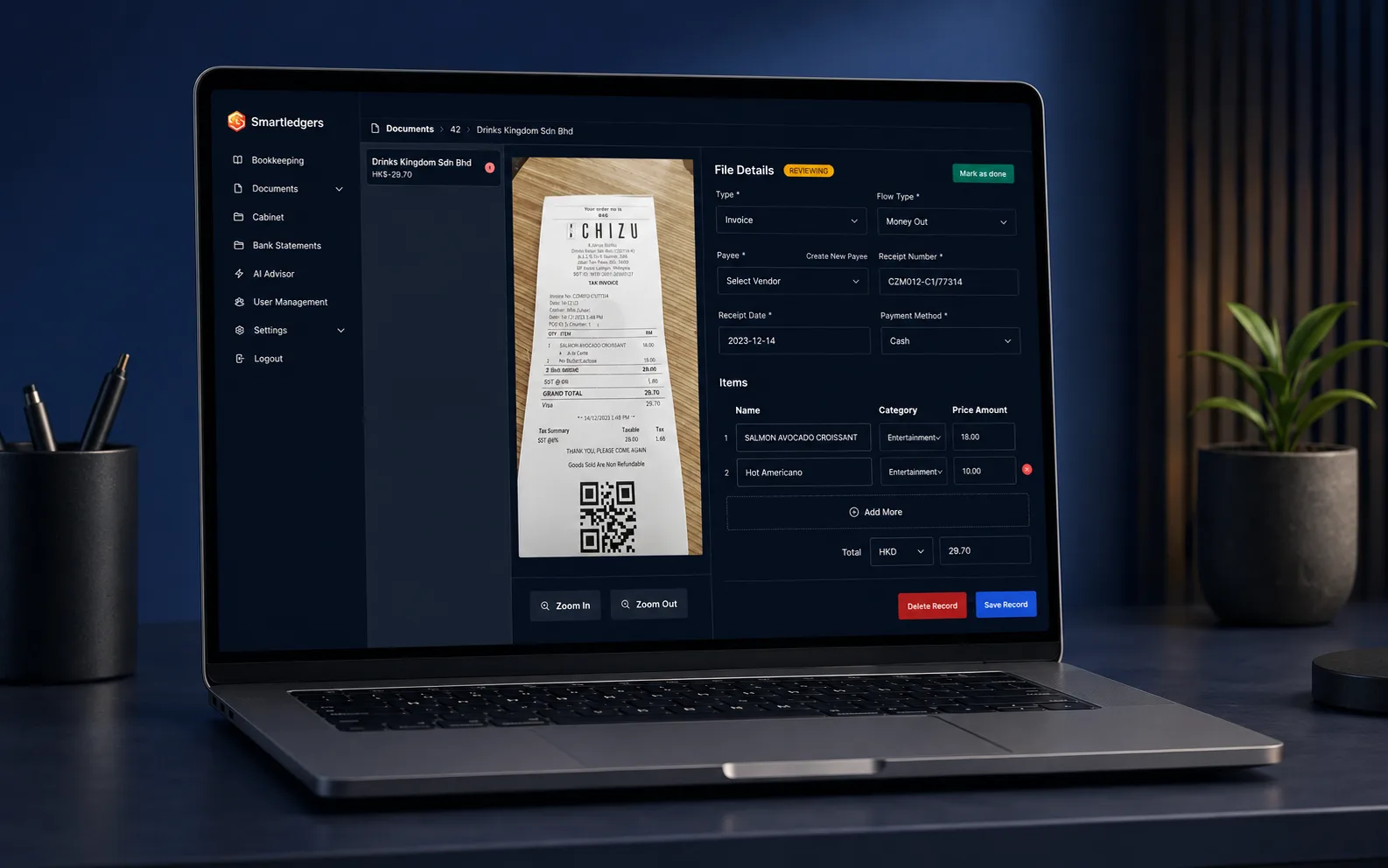
Look at how we built Smartledgers. Before automation, bookkeepers typed every field of every receipt and supplier invoice manually. With the AI workflow in place, the system reads every document, checks that line items and tax add up to the total, maps the likely account code and highlights only the fields with low confidence beside the original scan.
Instead of typing 100% of every document, a reviewer checks the handful of flagged lines and clicks approve, and only approved records sync to Xero or QuickBooks. Every entry carries an audit trail of what the AI extracted and who approved it.
That design gives you three things a chatbot never does:
- Automated calculation checks: totals, tax rates and duplicate invoice numbers are checked in normal code, never left to an AI model’s guesswork.
- Real speed: clean documents take seconds to confirm; messy scans stop safely for human judgement.
- Accountability: finance and auditors can see exactly who approved every posted figure.
Test on your own messy documents before committing a full build budget
Never buy an AI workflow based on a vendor’s clean sample invoice. Gather 20 to 30 of your real, awkward documents (crumpled thermal receipts, faded lorry delivery orders, multi-page supplier statements, handwritten amendments) and test how reliably the workflow extracts them and which real-world exceptions need a human rule.
How we can help
See how we build production AI workflow automation connected directly to your business systems, with your code, prompts and AI accounts kept in your company’s name.
Most SMEs start on Managed Delivery at RM19,000 a month with full technical ownership and live monitoring. That lets us release one high-volume workflow early and widen it once it proves its return, backed by our 7-Day Confidence Refund on month one. When one workflow’s inputs, approval rules and target system are settled, we can also lock the specification in a separate paid Scoping & Blueprint phase (from RM5,000) that your company owns, and build it as a fixed-scope Custom Project, from RM30,000.